

How to prepare and survive in times of uncertainty: a detailed guide
Lessons from Ukraine on preparing, staying safe during emergencies, and coping with crisis — both practically and mentally.
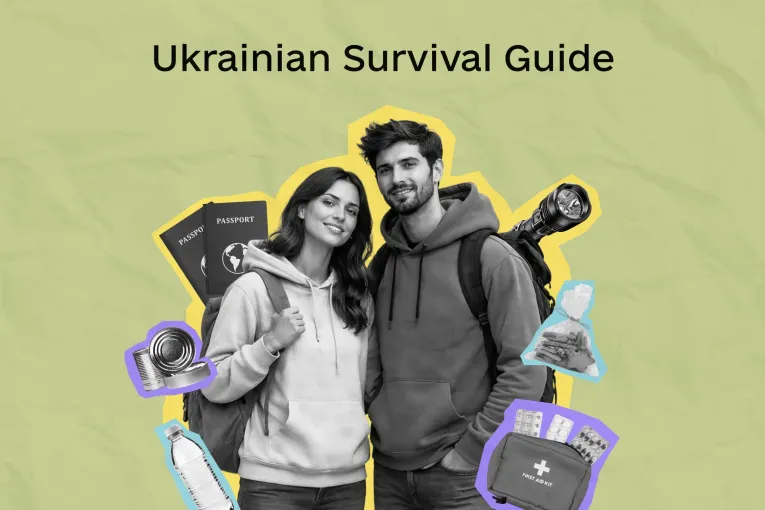
Why and for whom we created this guide
Four years of the full-scale war of Russia against Ukraine have taught Ukrainians what the world is only beginning to face: to live in uncertainty and to be prepared for emergencies.
As a result of Russia’s invasion, in the 2025 Global Peace Index, Ukraine ranked second among the least peaceful countries in the world. Years of hostilities have drastically changed everyday life, and, unfortunately, air raid alerts, power outages, problems with water supply and communication, damaged critical infrastructure, and logistics issues have become the new reality.
Yet Ukraine and Kyiv continue to live, study, work, implement changes, and even welcome foreigners who come to the capital. For example, according to the State Border Guard Service of Ukraine, in the first half of 2025, foreigners and stateless persons crossed the border into Ukraine almost 1.2 million times. Some come to see a country at war, some help to fight, and some even move here.
Every year, the number of wars and armed conflicts around the world increases. Surveys in the United States, the United Kingdom, France, and Germany show that about 40–46% of respondents consider World War III a real threat within the next five years. And the “War Index 2025” records an alarming 33% increase in military conflicts worldwide in 2025 compared to 2024.
This guide covers government-approved safety measures in Ukraine, as well as real-life situations that show what actually works—during power outages, natural disasters, and the escalation of armed conflict.
This guide will be useful for everyone, regardless of the country they live in, as emergencies (natural disasters, accidents, or infrastructure disruptions) can happen anywhere.
I. How to prepare for an emergency of technological, natural, socio-political, and military nature
1. Stay calm
Why it really matters: In a stressful situation, the body may react in different ways — fight, flight, or freeze. And although people sometimes act clearly according to a plan, panic often makes decision-making more difficult and slows reactions. When breathing evens out and attention returns to the body, it helps reduce stress levels, regain focus, and act more consciously. In critical situations, this can affect the speed and accuracy of decisions, and therefore safety.
Telling yourself to stay calm is easy, but doing it is much harder, so it is worth relying on the body: breathing and simple practices such as box breathing help restore control and calm down. In general, to restore inner balance, it is important to have anchors. These can be both knowledge and experience, as well as tangible things nearby. For example, a packed emergency bag is not only practical but also gives a sense of control when everything you need is at hand. And no less important are small, even ritualistic things, as they provide an additional point of calm and confidence,” comments Petro Shkliar, psychologist, gestalt therapist, group therapist, supervisor, trauma specialist, and specialist in working with emotions.
What to do:
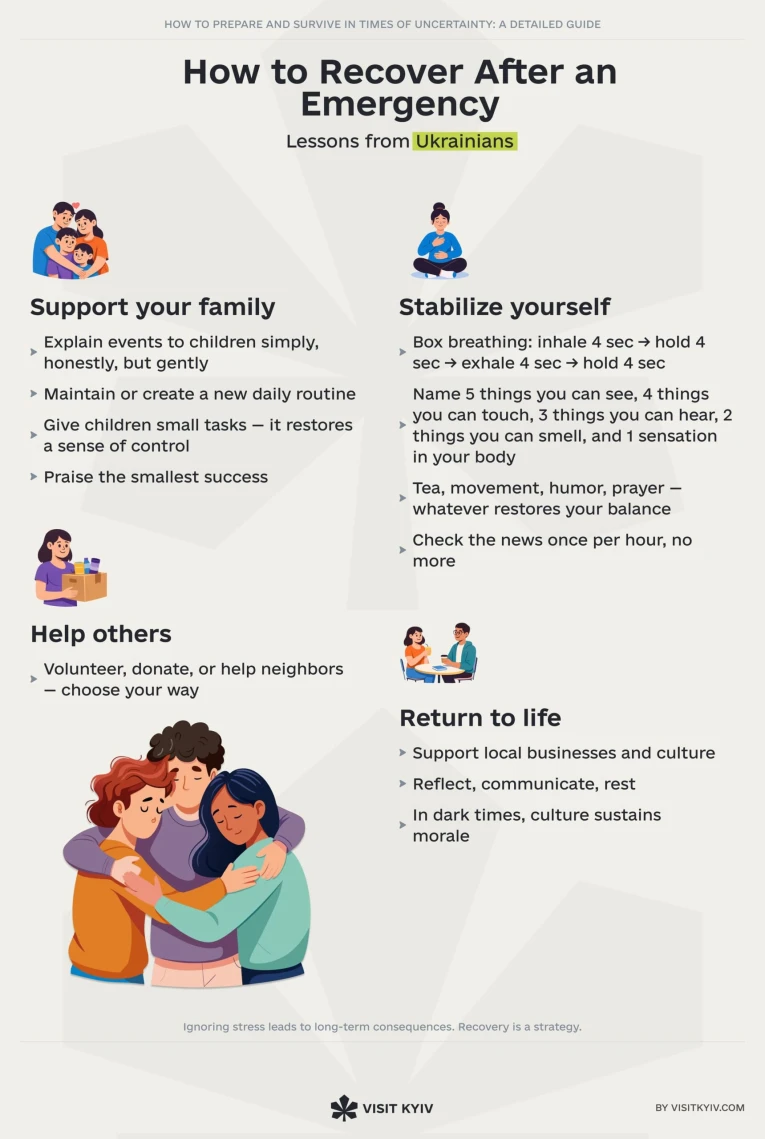
- Focus on your body and breathing. Do a simple breathing exercise, such as box breathing. Breathing pattern: inhale for 4 seconds, hold for 4 seconds, exhale for 4 seconds, and hold again for 4 seconds. At the same time, sit straight, relax your shoulders, and keep your feet on the ground. Continue breathing exercise for 3–5 minutes.
- Focus on your surroundings and what you feel. This helps shift attention from anxious thoughts back to reality. Name 5 things you see, 4 things you can touch, 3 sounds you hear, 2 smells, and 1 sensation in your body. Do this slowly, focusing on each point. This simple exercise helps calm you down and restore concentration.
- Follow only official information from government sources, special apps, or radio/television. Talk to neighbors — solving problems in a group may be easier.
- Maintain internet hygiene: do not constantly monitor the news; check reliable sources once an hour.
- Print or write down a list of important contacts (family, embassy, local emergency numbers) on paper.
- Use your own stress regulation tools. Do what stabilizes you and your resources. It can be tea, prayer, humor, meditation, light exercise — anything that restores your balance.
- Build your circle of communication and support. In a crisis, you don’t need to stay in touch with everyone at once — it only exhausts you and increases anxiety. Define your circle of care and stay connected with them
2. Prepare your home
Why it matters: Most life-threatening injuries during attacks or disasters are related to glass, gas leaks, or cold.
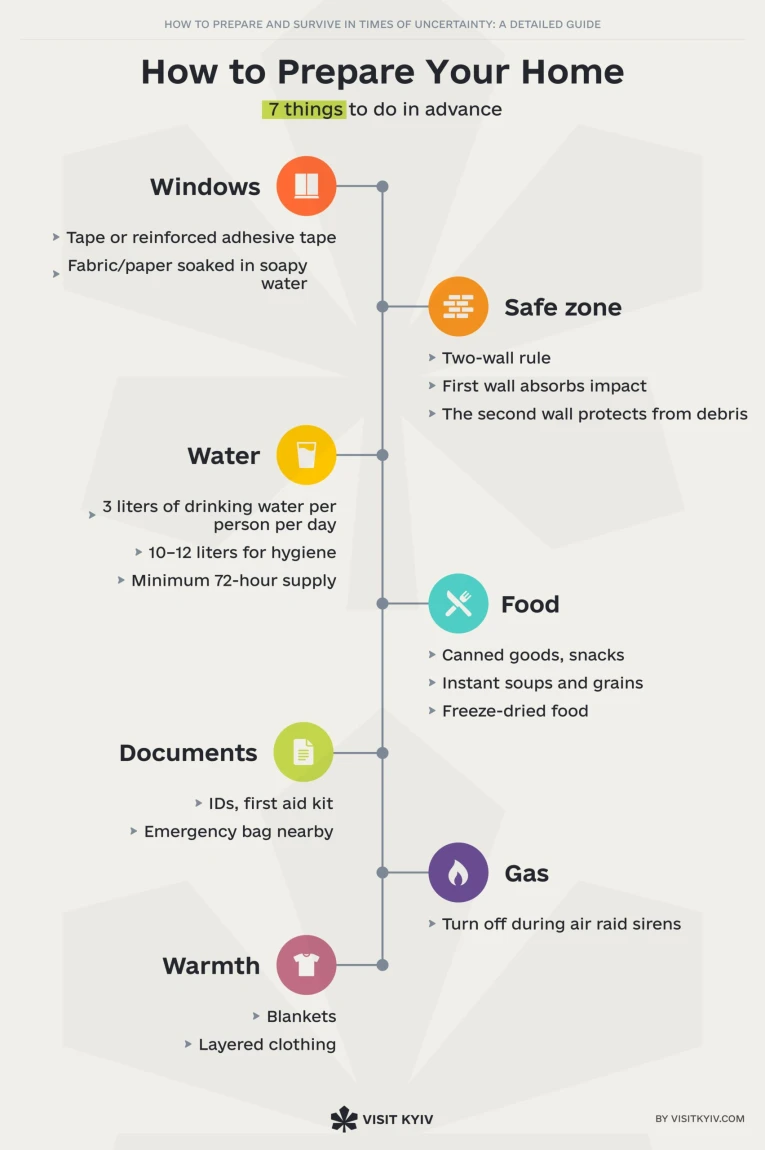 What to do:
- Protect windows. To reduce the risk of injury from glass fragments during a blast wave, use wide transparent tape, reinforced tape, masking tape, or strips of fabric/paper soaked in a soapy solution.
- Choose a relatively safe zone. Following the “two walls rule,” find a place in the room where you can hide during shelling. When there is no possibility of going to a shelter, this is a passive protection method: the first wall absorbs the blast wave and fragments, and the second protects against flying debris.
- Keep your documents, a first aid kit, and an emergency bag (see below for what it should contain) close to you, preferably in waterproof packaging.
- Prepare a blanket and layered clothing. This may be needed even in warm seasons, as shelters can be cold, especially at night.
- Stock up on water — both drinking and technical. Experts recommend 3 liters of drinking water per person per day, plus 10–12 liters for hygiene and cooking. Plan for at least 72 hours of supply.
- Stock up on long-shelf-life food and drinks: canned food (meat, fish, vegetables), snacks, instant soups and cereals, freeze-dried food, cookies, chocolate, nuts, dried fruits, pasta, powdered milk, tea, coffee.
- Fill a thermos with hot water for making tea or quick meals during outages.
- Use natural cold: in winter, store food on the balcony; in summer, in the coolest place protected from the sun.
- If your home has gas heating, turn off the gas during each siren.
3. Pack a backpack or bag for emergency evacuation
Why it matters: In a real emergency, there will be no time to pack. We have compiled a list of what you should have with you if you need to leave quickly, based on official recommendations.
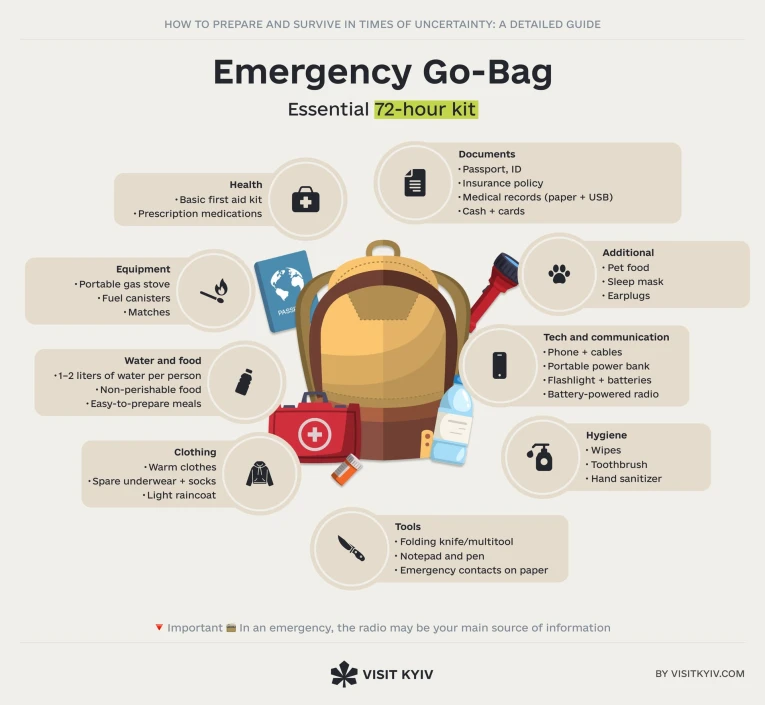 What should be in an emergency evacuation bag:
- Passport, ID, insurance policy, medical documentation (in paper form and on a flash drive)
- Cash and cards
- Basic first aid kit + prescription medicines
- 1–2 liters of water per person and long shelf life food that is easy to prepare (dry ready meals, energy bars, nuts, canned food)
- Portable gas stove, fuel canisters, matches, liquid fuel
- Basic set of dishes
- Warm clothing + spare underwear + socks
- Portable charger, phone, cables
- Flashlight + spare batteries
- Folding knife/multitool
- Small notebook and pen
- Hygiene kit: wipes, toothbrush, disinfectant
- Battery-powered radio (in emergencies, the radio can become the main source of information)
- Reusable cup and cutlery
- Printed or written list of the most important contacts
- Light raincoat
- Garbage bags
- Pet food
- Additionally: sleep mask, earplugs, comfort items
4. Digital and communication hygiene
Why it matters: In a crisis, it is necessary to consume and share information responsibly.
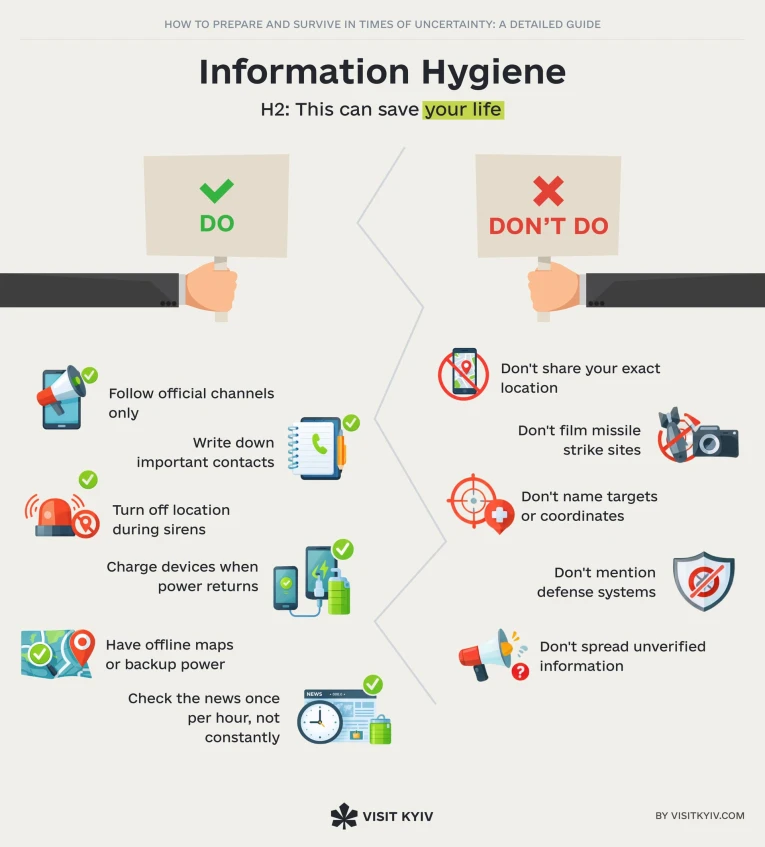
It is important to try to maintain balance: not to isolate yourself from the news, as a lack of information only increases anxiety, but also not to become emotionally immersed in it,” notes the psychologist. According to him, it is important to stay informed while holding yourself back from excessive emotional involvement, as if you are not a viewer who fully dissolves in what is happening. This is about the ability not to drop out of the information field, but also not to lose yourself in it. In crises, decisions and actions become key, rather than emotionally experiencing events.
What to do:
- Follow only official channels, such as government and city emergency apps.
- While in Ukraine, use apps such as Air Alert, Kyiv Digital, Diia, and follow updates on DSNS.gov.ua
- Key numbers should be written down on paper.
- Turn off geolocation and real-time posting when sirens sound.
- Have a spare charger or an offline map with you.
- Fully charge devices when power is restored.
What not to do:
- Do not post information about your exact location and videos from missile strikes on social media, as this may help the enemy adjust fire.
- Do not name targets and indicate coordinates on social media.
- Do not mention defense systems in your area.
- Do not spread unverified information and rumors. Every careless word can cause panic or harm.
It is extremely important to maintain live social contact, as digital communication can create an illusion of closeness,” emphasizes the expert. According to him, it is worth calling, using video calls, or, if possible, meeting in person. It is important to avoid spreading panic while also not withdrawing from communication.
Remember that information hygiene can literally save lives.
II. How to act in an emergency
5. What to do in an emergency related to military actions
Why it matters: In an emergency, your first actions directly affect your safety and your ability to navigate what comes next. A clear understanding of basic steps helps you stay composed and act more quickly.
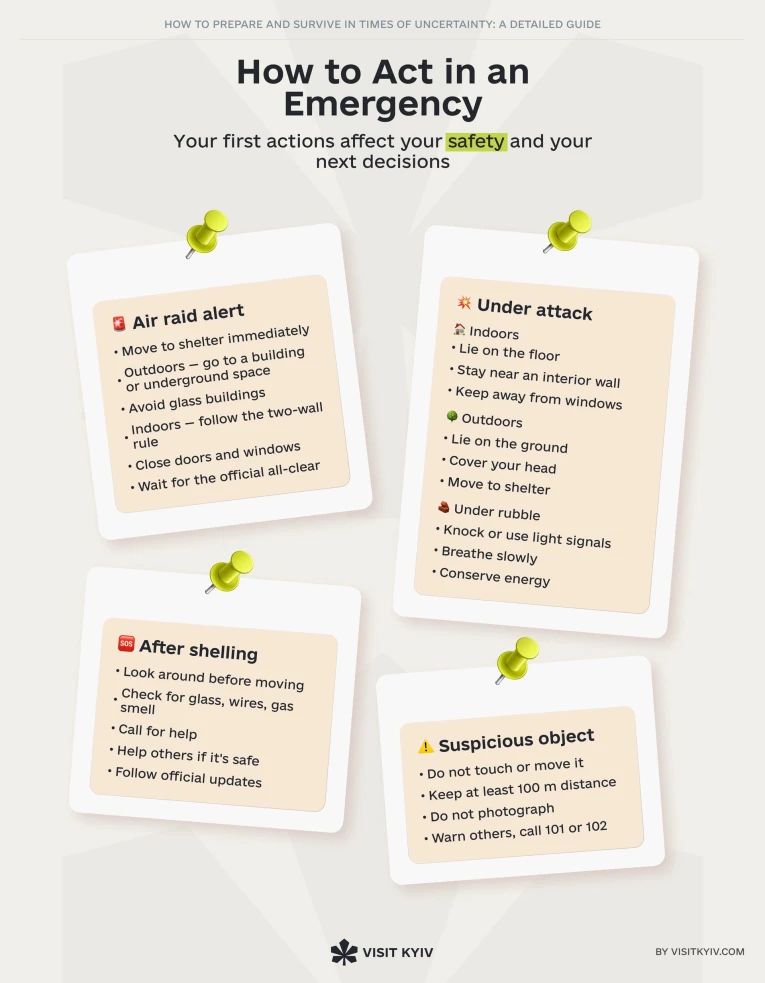 During an air raid alert, immediately move to a shelter. If you are outside — go to the nearest building or underground space (avoid glass buildings); if you are indoors — follow the “two walls rule” and close doors and windows. Wait for the official all-clear notification: if it is quiet, it does not mean the danger has passed.
During shelling, act according to the situation. If you are indoors, lie on the floor near an internal load-bearing wall, protect your head, and stay away from windows. If you are outside — lie on the ground, cover your head, and, if possible, move to shelter.
If you find yourself under rubble — signal for help (by knocking or using light), breathe slowly, conserve your energy, and wait for assistance.
After shelling, first look around: check for dangerous glass fragments, wires, or the smell of gas. Call for help if needed and assist others only if it is safe for you to do so. Rely on official information before leaving the area.
If you notice a suspicious object — do not touch, move, or approach it (at least 100 meters). Move away calmly and report it to emergency services (101, 102), warn others, and wait for their arrival.
III. How to recover and improve your condition after an emergency
6. How to regulate your psycho-emotional state
(based on instructions of the State Emergency Service and the experience of Ukrainians)
Why it matters: Ignoring stress can lead to long-term mental (PTSD) and physical illnesses.
What to do if someone is panicking or in a state of hysteria:
- Take this person to a calm place.
- Speak slowly, in simple words, confidently.
- Use short commands, for example: “look at me,” “breathe,” etc.
- Ask them to name 5 things they see, 4 things they can touch, 3 sounds, 2 smells, and 1 sensation in the body.
- Do not argue or shout; help the person focus, support them.
- After the emotional peak, it is normal for a person to feel tired; help them find a place to rest.
- Encourage with pride, for example: “We managed, we are holding on.”
When a person is in a hysterical state, it is important to appeal not to consciousness, but to the body — through breathing, a sense of safety, and basic comfort. It is not worth trying to explain anything or calm them with words; the key is to be there, to remain calm yourself, and to help the person restore their breathing and feel cared for. It is precisely through the bodily state that the psyche gradually stabilizes, and only after that are empathy and conversation appropriate,” adds Petro Shkliar.
7. How to help children and their families
Why it matters: Children are usually more vulnerable because they cannot take care of themselves. The family is a source of support and stability for them. At the same time, children primarily orient themselves not to the events around them, but to the state of their parents: if adults remain calm, even difficult circumstances become more manageable for the child. Conversely, parents’ anxiety, shock, or emotional instability can intensify fear and be more traumatic than the situation itself.
What to do:
- Be honest but gentle: explain events in simple language.
- Maintain a usual daily routine or create a new one.
- Allow children to help. Involve them in simple tasks, for example, ask them to bring a flashlight and thank them for their contribution.
- Play with the child: drawing and storytelling help overcome fears.
- Praise for every smallest success.
“Children primarily orient themselves to their parents, so the key to their calm is the calm of adults. It is important to share information with them, but not to place responsibility or your own anxiety on them. A child should understand what is happening, but not experience it at an adult level,” explains the psychologist.
8. Returning to life and helping others
Why it matters: During large-scale crises and destructive events, a person may lose the sense of their own significance and influence, which leads to apathy and helplessness. Returning to action, even through small steps, helps restore a sense of agency and control over one’s life. We cannot influence everything, but we can take manageable steps, and it is important not to devalue them. Helping others, including through volunteering or participation in communities, also provides a sense of belonging and support.
What to do:
- Gain energy and restore the sense that you can influence the situation by helping others: volunteer, donate, or visit elderly neighbors.
- Donate. Support only verified organizations and foundations.
- Support local businesses, art, and events because, in dark times, culture supports morale.
- Reflect, communicate, and rest, because recovery requires daily small steps.
“When we become useful to others, we regain our strength, a sense of our own significance, and agency. We feel that we are not just a leaf torn from a branch and spun by the wind at its will in the storm of difficult times. Rather, even if we are just an ant, we carry a piece of a leaf. We cannot lift a mountain, but we can lift this leaf and carry it somewhere,” comments the specialist.
Conclusion
We did not choose to be experts in crises, but adapted to alarms, power outages, displacement, and losses. And if our experience can be useful to at least one person, then this guide was worth preparing.
All the advice here is universal and practical. So wherever you are in the world and whatever happens, prepare in advance, stay calm, consume verified information, and believe that everything will be fine.


