


Murals and street art in Kyiv: a walking route through central Kyiv
See six well-known Kyiv murals on one walk through Reitarska and Striletska streets, starting near Zoloti Vorota.

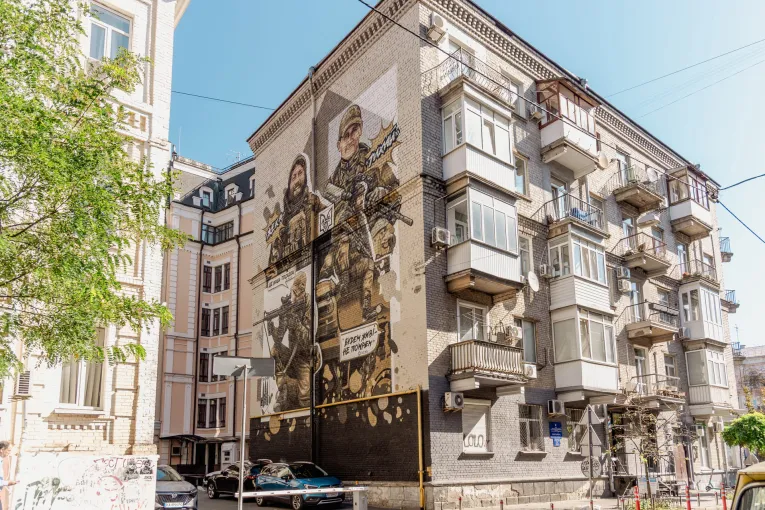
You can see works by artists from Ukraine, Australia, Poland, and Spain on a single walk through central Kyiv. There’s no need to cross the city: six murals are clustered along a few neighbouring streets near Zoloti Vorota.
The route starts on Reitarska Street, continues along Striletska, and finishes on Velyka Zhytomyrska. Most of the murals appeared in 2014–2015, when large-scale street art was becoming an increasingly visible part of Kyiv’s urban landscape.
But this walk is about more than six pins on a map. Between the murals, you’ll pass older buildings and courtyards, smaller graffiti, stickers, and other details that are easy to miss if you simply walk from one address to the next.
Route at a glance
Start: Zoloti Vorota metro station
Finish: 6-A Velyka Zhytomyrska Street
Time: around 1–1.5 hours with stops
Getting around: on foot
Main murals: 6
Best time to go: during daylight hours
Route: Zoloti Vorota → Reitarska Street → Striletska Street → Velyka Zhytomyrska Street
[Google Maps route]
From Zoloti Vorota to Reitarska
Start at Zoloti Vorota and head towards Reitarska Street. Within a few minutes, you’ll find yourself among older buildings, small courtyards, and local spots that give this part of central Kyiv its character.
The first mural is hidden inside one of those courtyards.
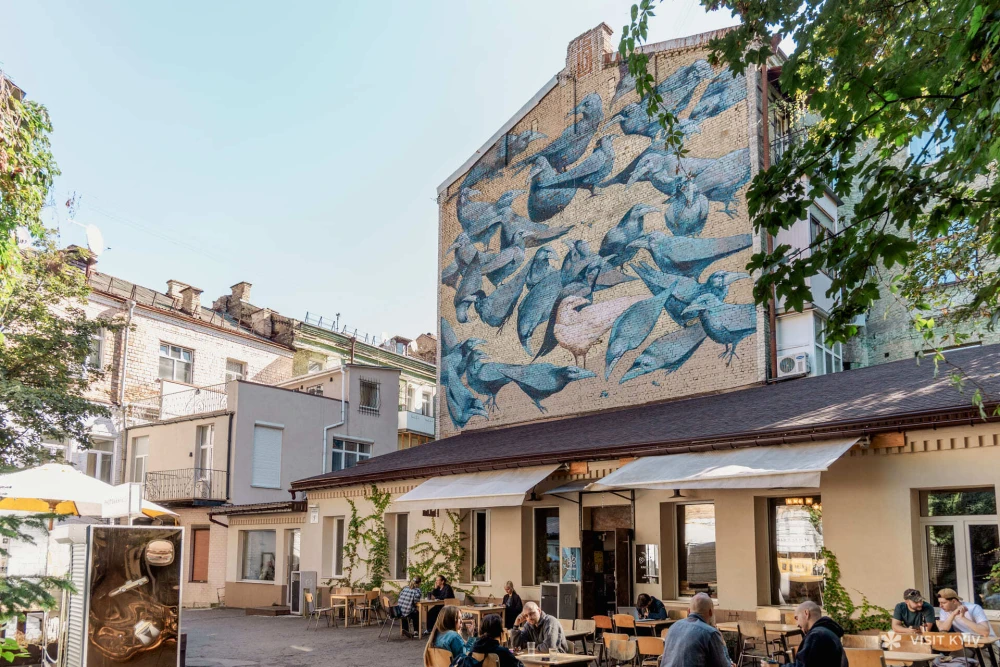
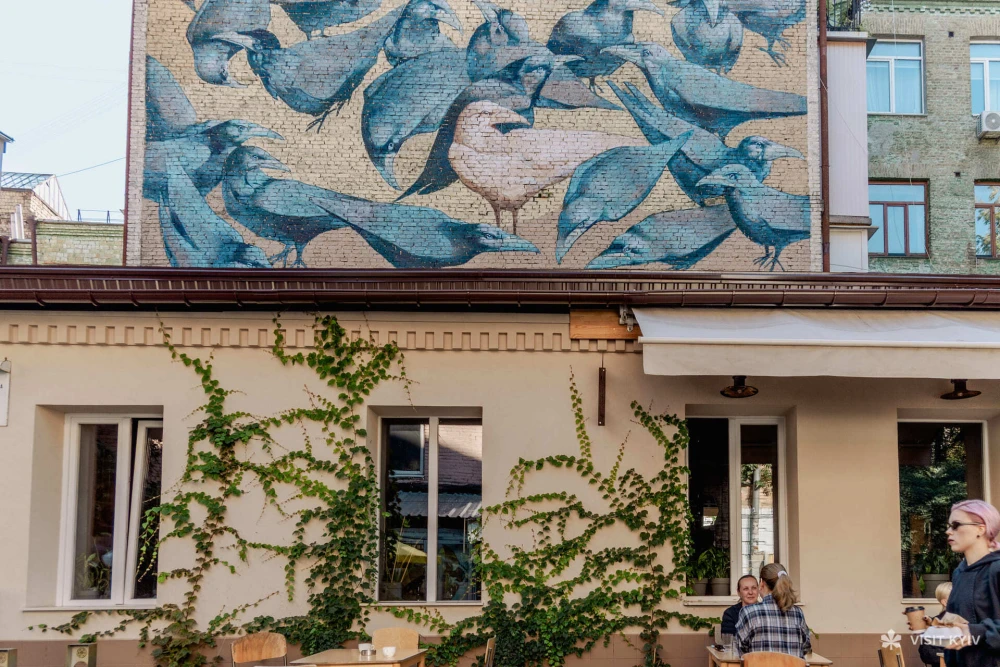
1. “Herald of Life”: find the white raven
7-B Reitarska Street
In a courtyard on Reitarska Street, one white raven stands out among a flock of black birds painted on the wall. This is Herald of Life, created by Ukrainian artist Oleksandr Britsev in 2015.
For the artist, the white raven symbolises good news and the beginning of new life, while the black birds represent wisdom. The idea came to Britsev after seeing black ravens against the snow one winter and wondering whether albino ravens existed.
What makes the mural even more interesting is its connection to the courtyard itself. Real ravens have lived here for years, giving their painted counterparts some very real neighbours.
Don’t rush off just yet. Take a look around the courtyard before heading towards Striletska, where the murals take on a very different scale.
2. “Time of Change”: look closer
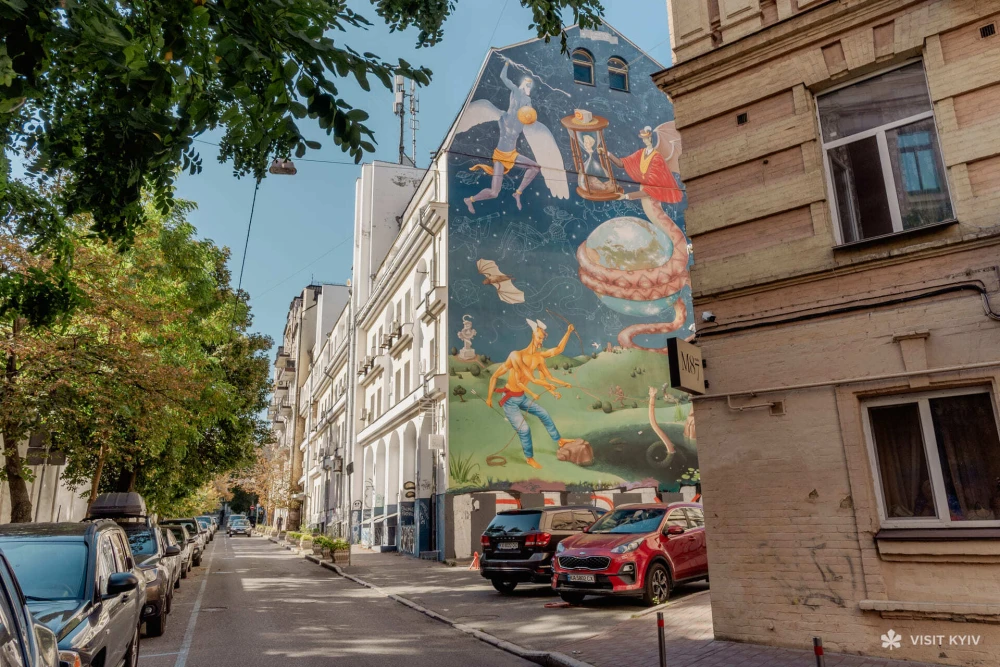
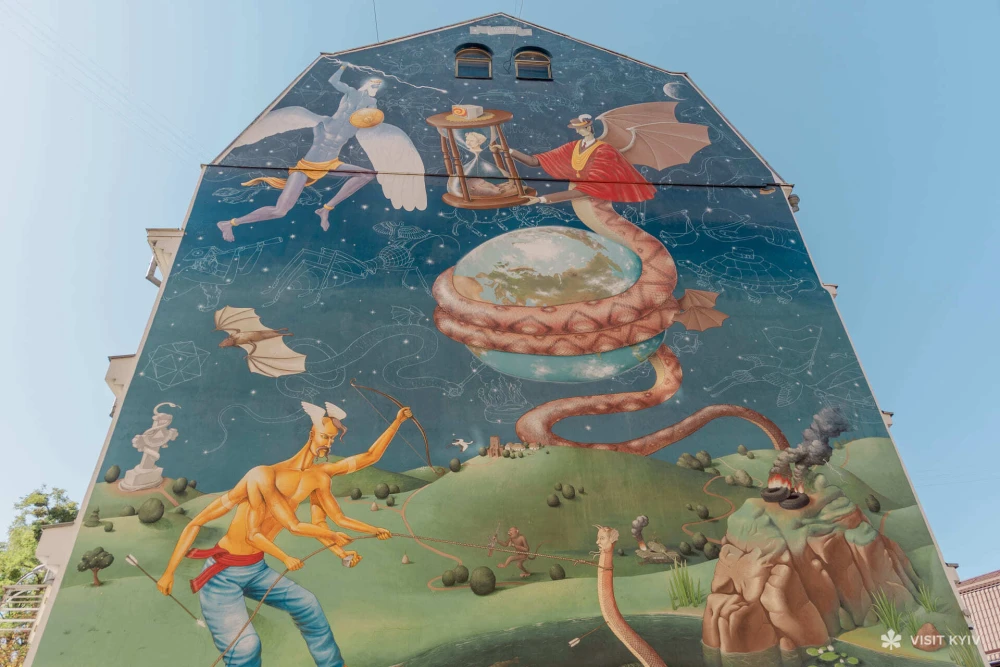
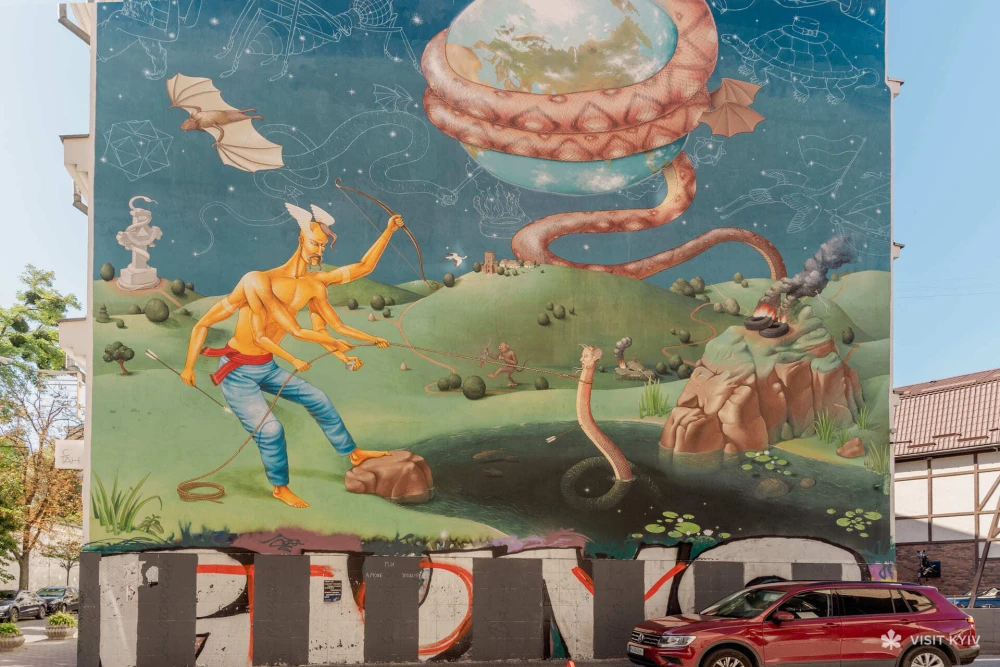
6 Striletska Street
Covering around 150 square metres, Time of Change feels more like a visual story than a single image. Ukrainian artists Volodymyr Manzhos and Oleksii Bordusov of the duo Interesni Kazki painted the mural in autumn 2014.
It was created following Russia’s annexation of Crimea and the beginning of the war in Donbas. At its centre, a many-armed Cossack confronts a snake coiled around the globe, while dozens of smaller images are hidden throughout the composition.
See if you can spot the burning tyres, a damaged tank marked “To Kyiv”, a monkey holding a grenade, and Lutsk Castle.
You might recognise the castle from Ukraine’s 200-hryvnia banknote. The artists reworked one small detail: on the banknote, a stork flies away from the castle; here, it is returning.
Give this mural a little more time than the others. At first, you see the whole composition. A few minutes later, smaller details start appearing everywhere.
3. “The Gymnast”: step across the street
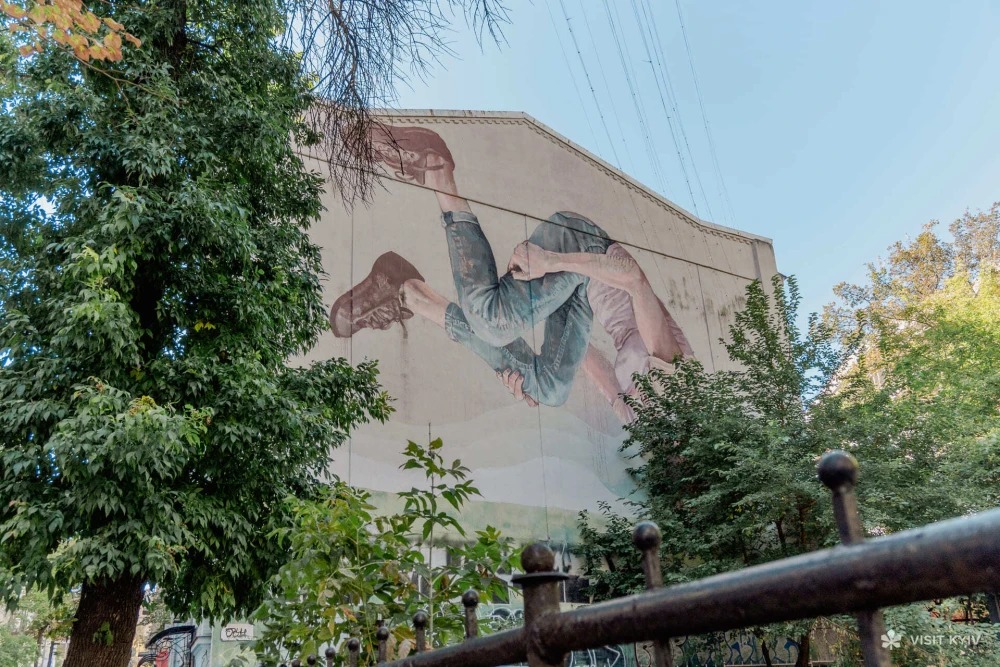
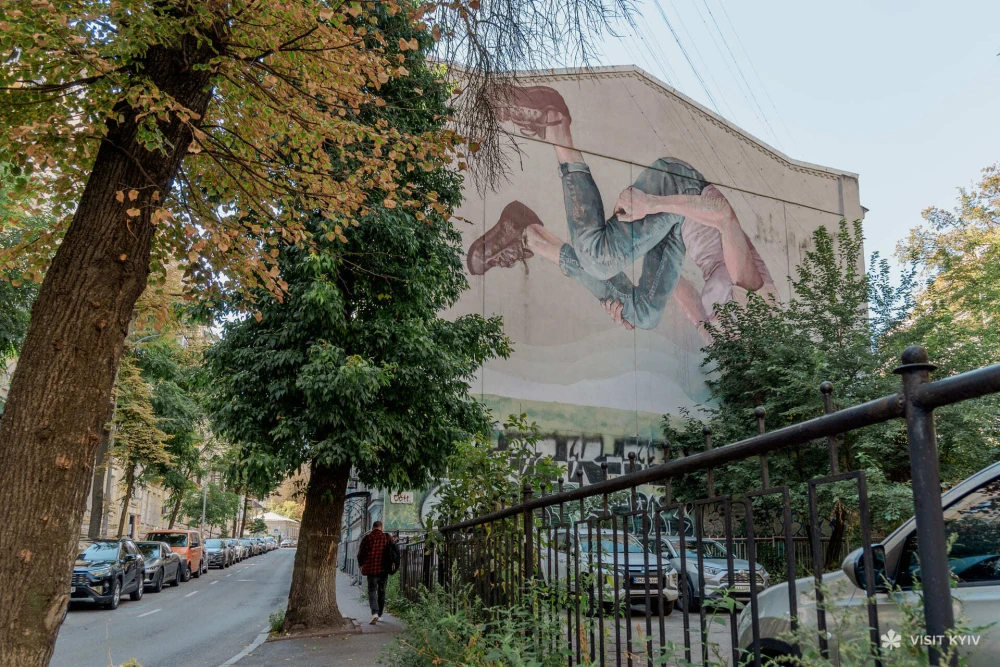
12 Striletska Street
The next mural is best seen from a distance. Cross to the other side of the street, and its scale becomes much clearer: the figure stretches across a large section of the building.
Australian artist Fintan Magee painted the mural in 2015, using Ukrainian rhythmic gymnast Anna Rizatdinova, who was born in Simferopol, as his model. The work is also known as The Dreamer.
After the dense symbolism of Time of Change, this mural feels much simpler to read. From across the street, you can see how the gymnast’s body seems to stretch with the building itself. Move closer, and smaller details begin to emerge.
4. “Carousel”: cars instead of horses
18 Striletska Street
A few minutes farther along Striletska, the human figures give way to something much more mechanical.
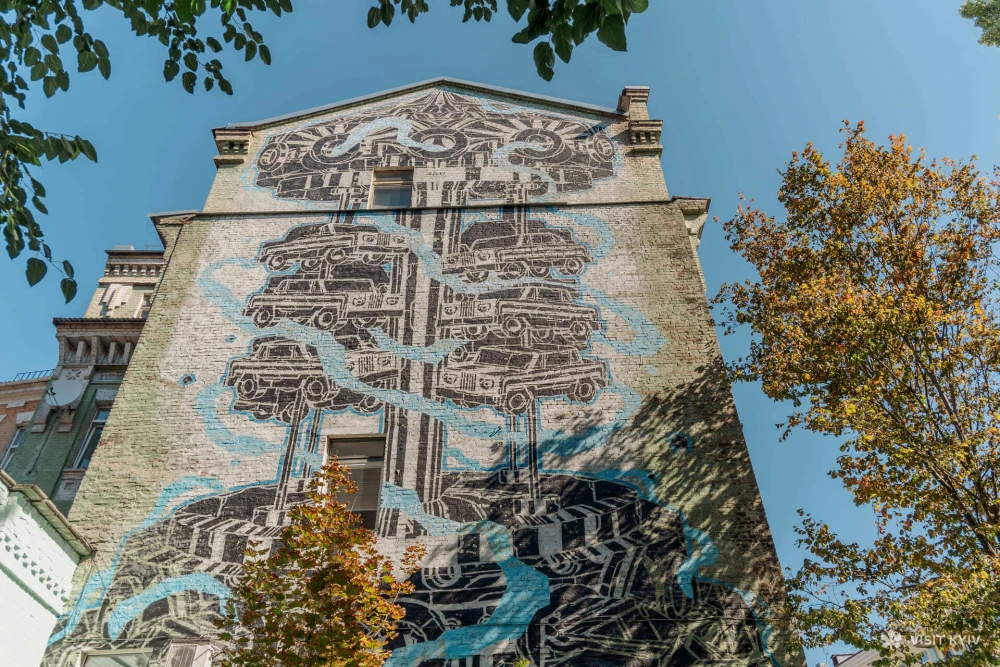
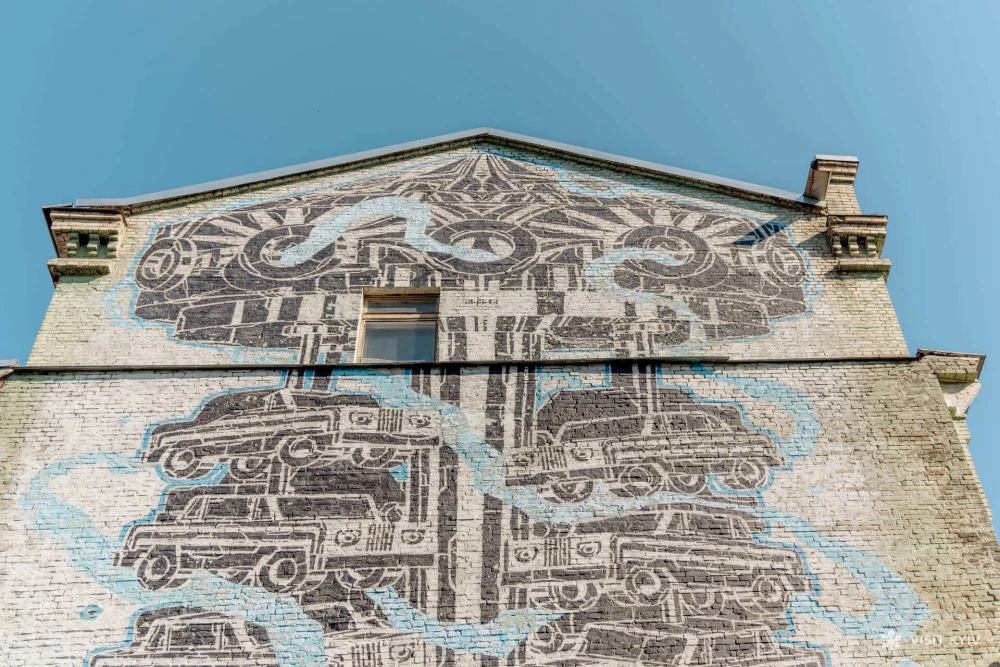
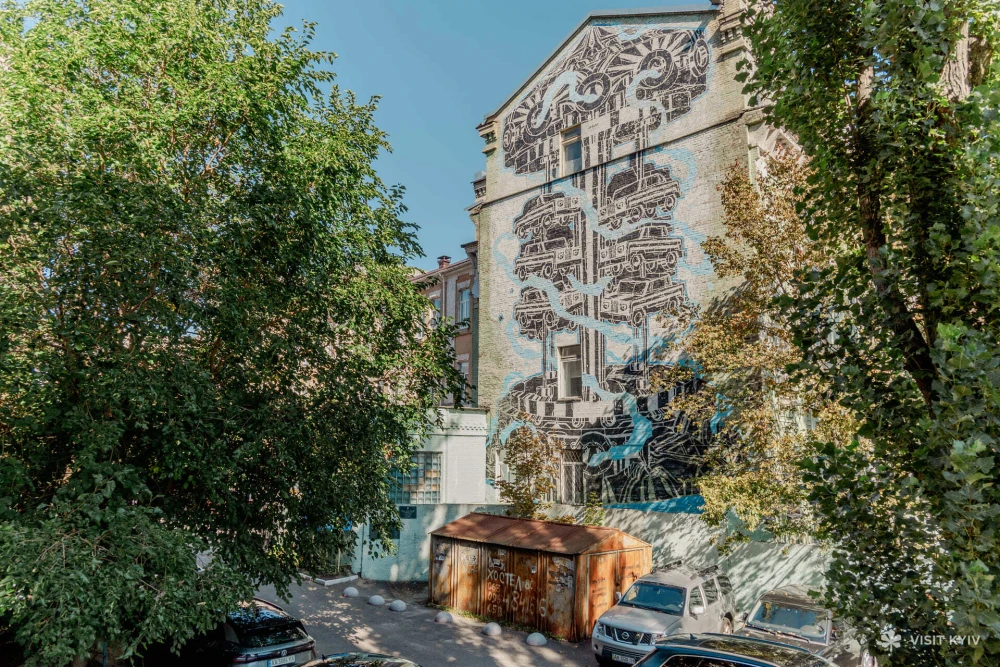
Polish artist Mariusz Waras, better known as M-City, created Carousel in 2015. The mural depicts a huge mechanism with cars moving around it in a circle. Most of the composition is black and white, broken up by a few blue details.
Machines, urban infrastructure, and industrial forms appear frequently in M-City’s work. Here, they become a kind of carousel, with cars taking the place of horses.
Look back at what you’ve already seen on Striletska and the contrast is striking: the surreal world of Time of Change, the lightness of the gymnast, and now M-City’s mechanical landscape. That variety is part of what makes this street worth walking rather than simply checking murals off a list.
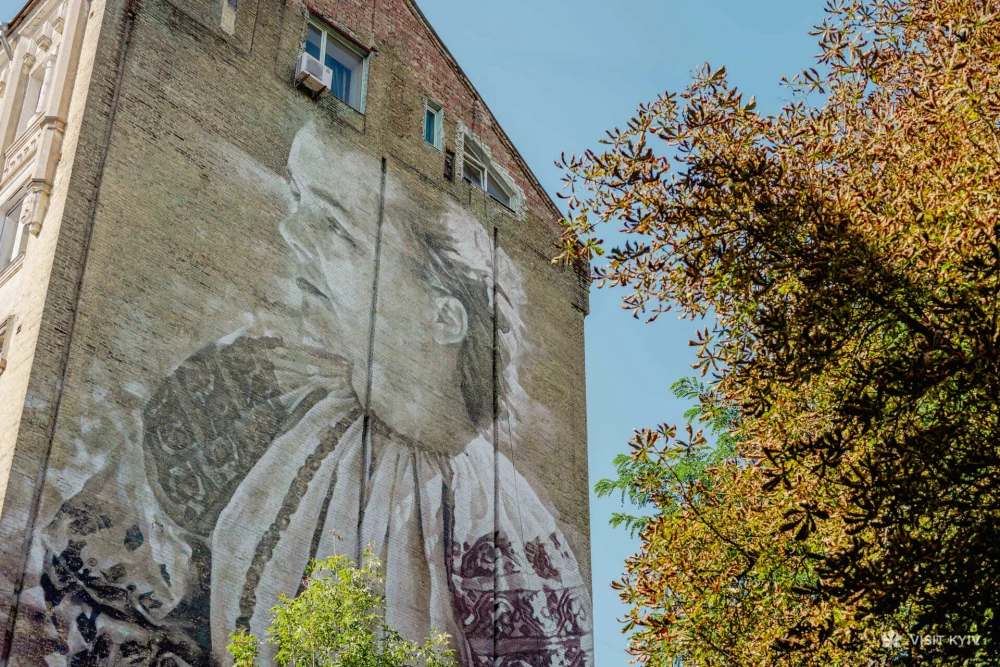
5. Lesya Ukrainka and “Lily of the Valley”
28 Striletska Street
At the last major mural on Striletska Street, the location matters almost as much as the portrait itself.
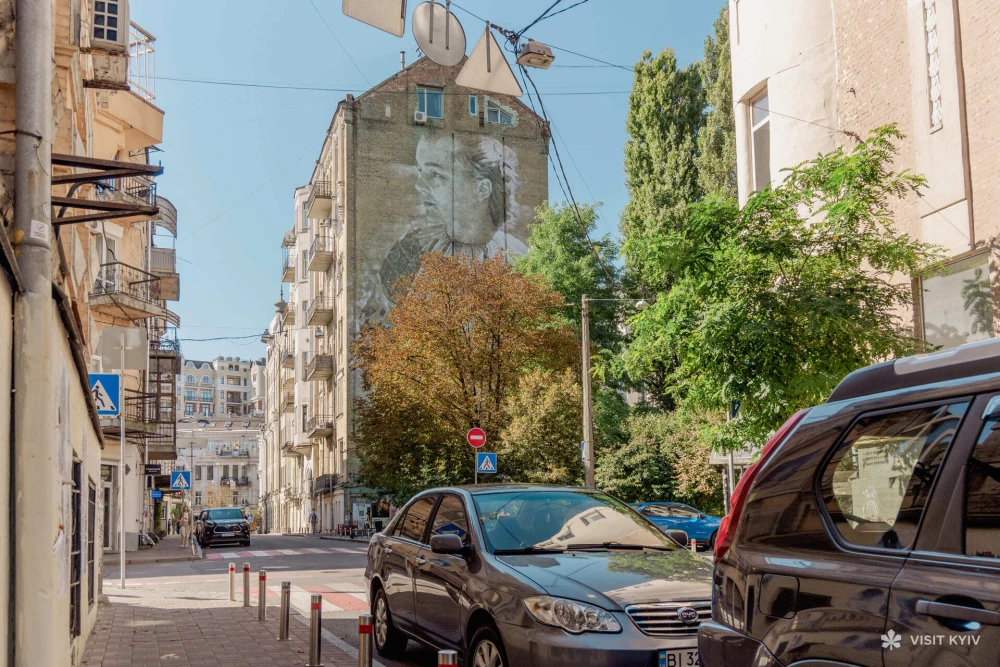
Australian artist Guido van Helten painted the mural in 2015. It depicts Ukrainian writer Lesya Ukrainka alongside lilies of the valley, inspired by her poem of the same name.
The location is meaningful too. Lesya Ukrainka lived on Striletska Street for a period of her life, so her portrait now appears on a street that was once part of her own Kyiv.
Up close, you can make out the flowers and details of the portrait. From across the street, you get the full composition.
Put the map away for a few minutes
From Striletska, make your way towards Velyka Zhytomyrska Street. For this part of the walk, try not to spend the whole time looking at your phone.
Large murals are only the most visible layer of Kyiv’s street art. Look at the walls, gates, and courtyards and you’ll find smaller graffiti, stickers, and other pieces along the way. They change much faster than the large murals: some disappear, while new ones take their place.
That’s why there are no coordinates for this part. Just keep your eyes open. Some of what you see today may be gone or replaced the next time you walk these streets.
6. Aryz’s mural: the final stop on Velyka Zhytomyrska
6-A Velyka Zhytomyrska Street
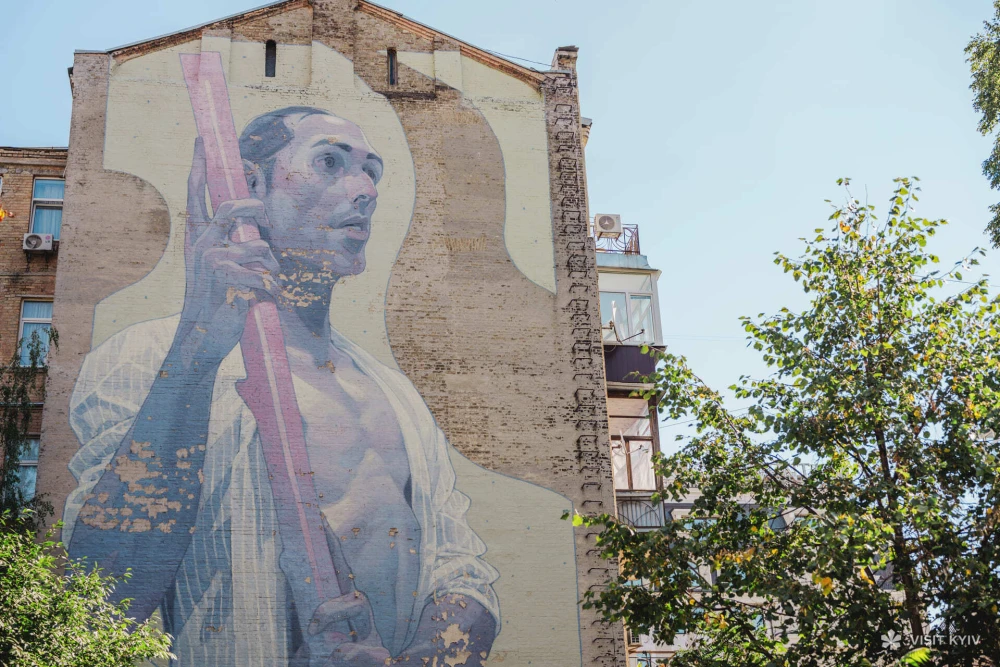
The final mural is hard to miss. A huge male figure in an open shirt covers almost the entire facade, holding a long object that resembles a flagpole.
Spanish artist Aryz, known for his large-scale human and animal figures, painted the mural in 2015.
In Kyiv, the work is often referred to as A Glimpse into the Future, although the image itself leaves plenty of room for interpretation.
Its scale is what stands out most. The figure dominates the facade, creating a striking contrast with the older buildings along Velyka Zhytomyrska.
This is the last mural on the route, but you’re still right in the heart of Kyiv, so there’s no need to end your walk here.
Where to go next
The mural route ends on Velyka Zhytomyrska, but there are several good options nearby if you want to stay in the area.
Hlek, 6 Velyka Zhytomyrska Street — a contemporary Ukrainian restaurant almost next door to the final mural. A convenient stop for lunch or dinner.
Dolceteka Bassano, 8/14 Velyka Zhytomyrska Street — a good option for coffee, pastries, or dessert before you continue exploring.
B-Hush, 2-A Velyka Zhytomyrska Street — a panoramic restaurant and lounge bar overlooking Kyiv’s historic centre. Save this one for later in the afternoon or evening.
St Sophia’s Cathedral and Être Sofie. If you’re still in the mood to walk, continue towards Sofiivska Square and St Sophia’s Cathedral, one of Kyiv’s most important historic landmarks and part of a UNESCO World Heritage Site. Être Sofie is located within the reserve, so you can combine your visit with lunch or dinner.
From there, continue through Mykhailivska Square to Volodymyrska Hill, or keep exploring Old Kyiv.
FAQ

The area around Zoloti Vorota works well for a self-guided street art walk. Several well-known murals are clustered along Reitarska, Striletska, and Velyka Zhytomyrska streets. You’ll find street art elsewhere in Kyiv too, but this route lets you see several major works without covering a large part of the city.
Allow around 1–1.5 hours. You can cover the distance faster, but it’s worth leaving time to look at the murals, explore the courtyard on Reitarska, and notice smaller pieces of street art along the way.
Yes, but daylight is better for this route. You’ll be able to see the details of the large murals more clearly and spot smaller street art along the way.
No. All six murals are free to view. Parts of the route pass residential buildings and courtyards, so please be respectful of the people who live there.


