Banking in Ukraine for foreigners: how to pay and open an account
Using cards, withdrawing cash, and sending money in Ukraine.

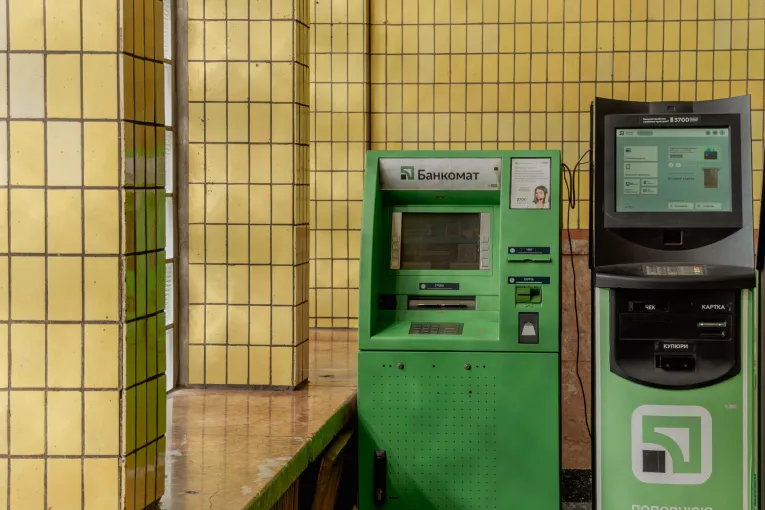
In Kyiv, you can pay for coffee, a metro ride, or a taxi simply by tapping your card or phone. Despite Russia’s full-scale invasion, Ukraine’s banking system continues to operate, and contactless payments and mobile banking remain part of everyday life.
For a short visit, a foreign Visa or Mastercard and a little cash in Ukrainian hryvnia are usually all you need. If you’re staying longer, opening a local bank account might make everyday life easier.
Here’s what you need to know about banking in Ukraine, from paying for purchases and withdrawing cash to choosing a bank and opening an account.
How do banks in Ukraine operate during the war?
Banks in Ukraine continue to serve customers under martial law. Branches, ATMs, card terminals, banking apps, and money transfer services remain available, although individual services can be disrupted. The National Bank of Ukraine (NBU) regulates the country’s banking system.
Bank branches may temporarily close during air raid alerts, while power outages can affect ATMs and card terminals.
Ukraine has established the POWER BANKING network to help people access essential banking services during longer outages. Participating branches have backup power and can provide basic services, including cash withdrawals, depending on cash availability and technical conditions.
If you’re visiting Kyiv, it’s also worth reading our guide to power outages in Kyiv so you know what to expect.
How to pay in Ukraine: card, phone, or cash?
You can pay by card for most everyday purchases in Kyiv. Supermarkets, pharmacies, restaurants, cafés, hotels, and shopping malls generally accept card payments. Still, there are situations where having some cash comes in handy.
Can you use a foreign debit or credit card in Ukraine?
Yes. Most foreign Visa and Mastercard debit and credit cards work in Ukraine, so you usually won’t need a Ukrainian bank account for a short trip.
Before travelling, check:
- Whether your bank allows transactions in Ukraine.
- What foreign transaction fees and currency conversion charges apply.
- Whether you can approve payments through your banking app while abroad.
Some banks flag unfamiliar transactions for security reasons. Check your card settings before leaving and let your bank know about your trip if it recommends doing so.
Where can you make contactless payments?
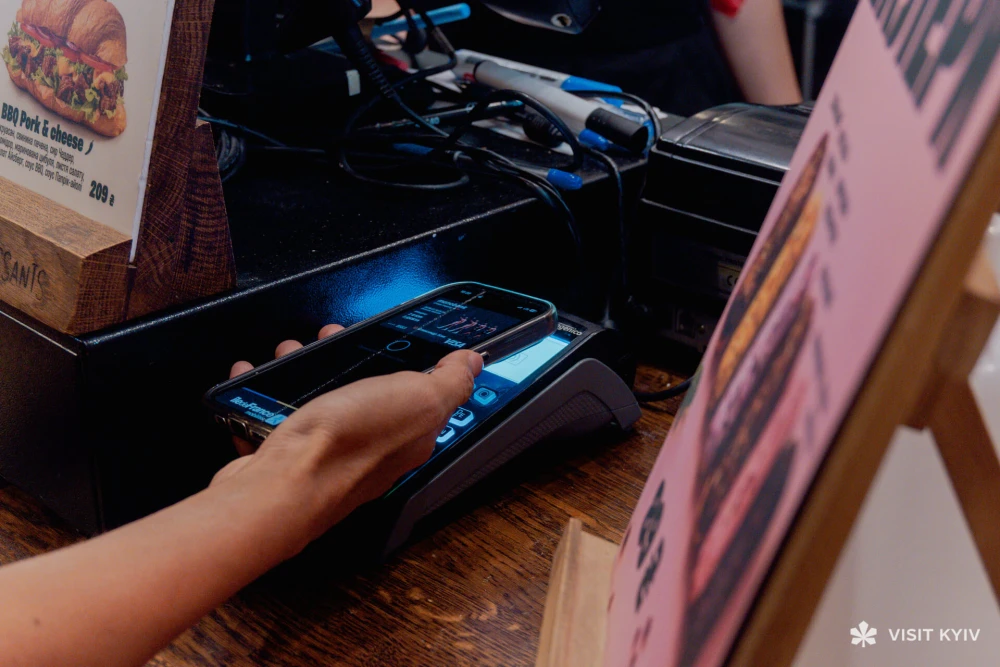
Contactless payment is widely available across Ukraine. You can use a physical card, Apple Pay, Google Pay, or another supported digital wallet wherever the terminal accepts contactless transactions.
In Kyiv, you can also tap your card or phone to pay for public transport. At metro stations, use a contactless-enabled turnstile. On buses, trolleybuses, and trams, tap the validator inside the vehicle.
For more details, see our guide to public transport in Kyiv.
Should you carry cash in Kyiv?
Yes, it’s worth keeping a small amount of cash with you, even if you mostly pay by card.
You might need hryvnia at smaller markets, some kiosks, on certain minibuses known as marshrutkas, or when a card terminal is temporarily unavailable.
Use your foreign bank card for most purchases, but keep some cash as a backup. Having a second card can also help if your main one is blocked or stops working.
Hryvnia, currency exchange, and cash withdrawals
Ukraine’s official currency is the hryvnia (UAH, ₴). Prices in shops, restaurants, hotels, and on public transport are listed in hryvnia. You can’t normally pay for everyday purchases in cash using euros or US dollars.
You don’t need to exchange all your money before arriving. When you pay with a foreign card, your bank and payment network handle the currency conversion.
Which currency should you choose when paying by card?
Imagine your dinner in Kyiv costs UAH 1,000, but your bank account is in euros.
The payment terminal might ask whether you’d like to pay in UAH or EUR. Choosing euros may trigger dynamic currency conversion, where the terminal provider sets the exchange rate. That rate can be less favourable than the one offered by your card network and bank.
Your bank and card network will then handle the conversion, although foreign transaction fees may still apply. The same advice applies when an ATM offers to convert your withdrawal into your home currency.
Where can you find an ATM, and what are the withdrawal limits?
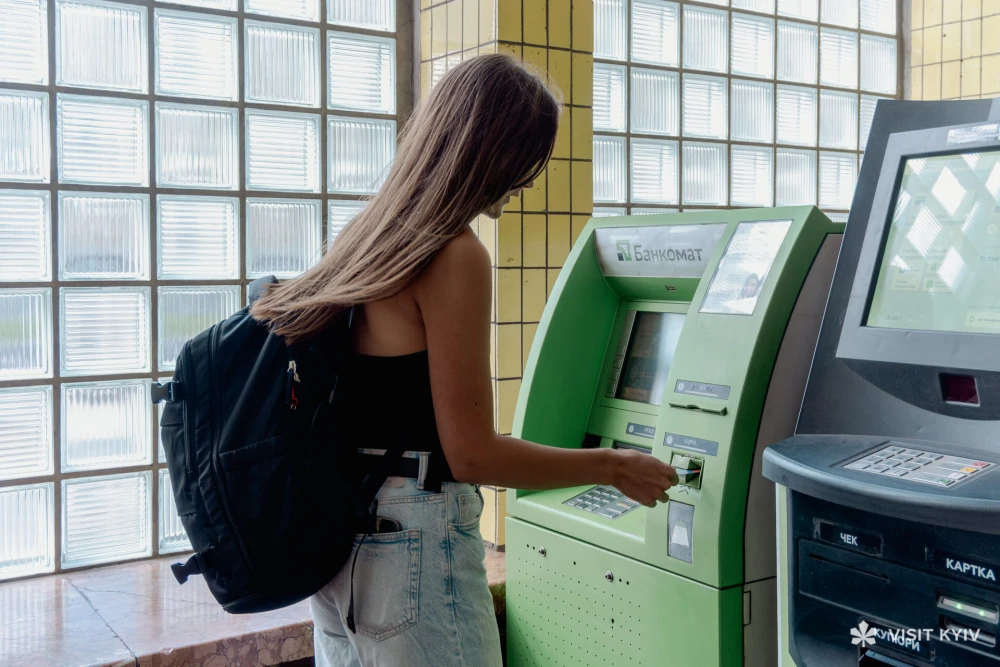
ATMs are available at bank branches, shopping malls, larger supermarkets, and throughout central Kyiv.
You can withdraw cash at ATMs operated by major banks, including PrivatBank, Oschadbank, and Raiffeisen Bank.
Before confirming a withdrawal, check the fee, the currency conversion option, and the exchange rate. Your home bank may charge an international withdrawal fee, and the ATM operator may apply its own charges.
Ukraine has restrictions on certain cash transactions during martial law. A general daily withdrawal limit of UAH 100,000, or the equivalent, applies to individual accounts at Ukrainian banks, with some exceptions.
If you’re using a foreign card, your actual withdrawal limit may be different. It depends on your card issuer and the ATM operator.
Because banking rules can change, check the current limits with your bank before making a large withdrawal.
Where should you exchange foreign currency?
You can exchange money at bank branches and licensed currency exchange offices.
Before exchanging cash, check the displayed exchange rate and the difference between:
- Buying rate: How much hryvnia you’ll receive when selling euros or US dollars.
- Selling rate: How much hryvnia you’ll pay when buying foreign currency.
The official NBU rate may differ from the rates offered by banks and exchange offices. You can check the latest figures on the National Bank of Ukraine website.
Avoid exchanging money with people on the street, even if they offer a better rate.
For more practical advice, read our guide to money and currency exchange in Kyiv.
Can foreigners open a bank account in Ukraine?
Yes. Foreigners, including non-residents, can apply to open a bank account in Ukraine. Whether an application is approved depends on your documents, immigration status, and the bank’s requirements.
You don’t necessarily need to be a Ukrainian tax resident to apply. However, the bank must verify your identity, understand why you’re opening the account, and sometimes ask where your money comes from.
For a short visit, a Ukrainian bank account is rarely necessary. If you’re moving to Kyiv, studying, or working here, a local account can make it easier to pay rent and utilities, receive payments, and transfer money using Ukrainian bank details.
Depending on the bank, you may be able to open an account in hryvnia or a foreign currency such as euros or US dollars.
Best bank in Ukraine for foreigners: what should you look for?
There isn’t one best bank in Ukraine for foreigners. The right choice depends on your documents, how long you’re staying, and what you need the account for.
When comparing banks in Ukraine, focus on whether they accept non-resident applications, what documents they require, whether English-language support is available, and how easy their banking app is to use.
Here are three options worth checking.
PrivatBank: for everyday banking and branch access
PrivatBank is one of Ukraine’s largest banks, with an extensive network of ATMs, payment terminals, and branches.
Its Privat24 banking app lets customers manage accounts, pay bills, transfer money, and exchange currency.
Foreigners need to complete the bank’s identity and document checks before opening an account. It’s best to contact a branch first to confirm whether your immigration status and documents meet its requirements.
People who want easy access to ATMs and branches, alongside a mobile app for everyday banking.
Raiffeisen Bank: for longer stays in Ukraine
Raiffeisen Bank is another option to consider if you’re planning to open a local account.
The bank has an English-language website and provides information about banking services for non-residents. The documents required will depend on your individual circumstances.
Customers can use the MyRaif app to manage accounts and make payments. The bank also offers accounts in hryvnia and foreign currencies, including euros and US dollars.
Foreigners planning a longer stay who want to review the bank’s non-resident requirements before applying. Keep in mind that an English-language website doesn’t necessarily mean English-speaking staff will be available at every branch.
monobank: for mobile-first banking
monobank is known for its app-based approach to banking. Customers can handle most everyday transactions on their phones without visiting a traditional bank branch.
However, the straightforward registration process available to Ukrainian citizens may not work for someone using a foreign passport.
Eligibility depends on the documents the bank accepts and the outcome of its identity checks.
Foreigners who meet the bank’s requirements and prefer to manage their finances through a mobile app. If you don’t have Ukrainian digital identity documents, it’s worth checking the account-opening requirements at PrivatBank or Raiffeisen Bank first.
How to open a bank account in Ukraine
If you’ve searched for “how to open a bank account in Ukraine”, here’s what to expect. You’ll usually need to prepare your documents, verify your identity, and sign an agreement with the bank. The exact process depends on your residency status and the bank you choose.
What documents do foreigners need?
Banks set their own documentation requirements, but you may be asked for:
- A valid passport. A certified Ukrainian translation may also be required.
- A Ukrainian tax number. Officially known as the Registration Number of the Taxpayer’s Account Card (RNOKPP).
- Proof of address. This could be a residence permit or another document accepted by the bank.
- Proof of your legal stay in Ukraine. The bank may request documents confirming your immigration status.
- Information about your income. You may need to explain your employment, source of funds, or intended account activity.
Not having a Ukrainian residence permit doesn’t automatically mean you can’t open an account. However, additional checks may apply if you’re visiting under a short-term visa or visa-free arrangement.
How do you get a Ukrainian tax number?
If you don’t already have a Ukrainian tax number, you can apply through the State Tax Service of Ukraine.
The standard process generally requires an application using Form No. 1DR, your passport, and a properly certified Ukrainian translation. Different documentation rules may apply to holders of temporary or permanent residence permits.
Under the standard procedure, registration in the taxpayer register takes three business days after the required documents are submitted.
Getting a Ukrainian tax number doesn’t automatically make you a Ukrainian tax resident.
You can find the latest requirements on the State Tax Service website.
How to open an account: step by step
Step 1. Check whether the bank accepts non-residents.
Contact the bank, explain your immigration status, and ask whether your documents are sufficient. It’s also worth checking whether English-language assistance is available.
Step 2. Prepare your documents.
Gather everything the bank requests. If you need a Ukrainian tax number or a passport translation, arrange these in advance.
Step 3. Visit a branch.
A bank employee will review your documents and ask you to complete an application. You may be asked about your address, employment, source of funds, and why you need the account.
Step 4. Complete the checks and sign the agreement.
The bank will verify your identity and may request additional supporting documents.
Step 5. Get your account details and set up mobile banking.
Once your account is open, you’ll receive its details, including your IBAN. Depending on the bank, a digital debit card may be available immediately, while a physical card may arrive later.
How long does it take?
If your documents are ready and no additional checks are needed, you may be able to open an account during a single branch visit.
For non-residents, however, verification can take several business days or longer.
If you also need a Ukrainian tax number, allow extra time for that process. Contacting the bank before your visit can help you avoid unnecessary delays.
How to open an online bank account in Ukraine
You might have come across the search “how to open an online bank account in Ukraine”. The short answer is that not every foreign applicant can open a Ukrainian bank account remotely. It depends on the bank and whether your identity documents are accepted for online verification.
Even with a Ukrainian residence permit, you may still need to visit a branch.
Before downloading a banking app and starting the registration process, ask the bank whether your documents are eligible for remote account opening.
Ukraine also has an e-residency programme for foreign entrepreneurs. It offers a separate route for registering a business remotely and opening an associated account, but it isn’t a substitute for a regular personal bank account.
Banking fees, foreign currency accounts, and international transfers
Some Ukrainian banks offer debit cards with no account-opening or monthly maintenance fee. Other services, including cash withdrawals, currency exchange, and international transfers, may cost extra.
What fees and restrictions should you check?
Before opening an account, compare:
- Account-opening and monthly maintenance fees.
- ATM withdrawal charges, especially at other banks’ ATMs.
- Fees for transfers between accounts or cards.
- Currency conversion rates.
- International transfer charges.
- Restrictions on account activity during martial law.
It’s also worth understanding the difference between a debit card and a credit card. A debit card lets you spend money already in your account, while a credit card allows you to borrow up to an approved limit.
For most everyday expenses, a debit card is enough. Applying for a credit card generally involves additional eligibility and credit checks.
How do international transfers work?
If you need to receive money from abroad, your Ukrainian bank can provide the account details required for an international transfer.
The main identifier is your IBAN (International Bank Account Number). Ukrainian IBANs begin with UA and contain 29 characters.
For a SWIFT transfer, you may also need the recipient’s full name, the bank’s details, and other information depending on the payment.
Transfer times vary based on the banks involved, the currency, and any additional checks.
There is an important distinction between receiving money in Ukraine and sending money abroad from a Ukrainian account. Different rules may apply.
During martial law, the NBU restricts certain international transactions. Check the latest regulations and your bank’s requirements before sending money overseas.
Do PayPal, Revolut, Wise, and other payment services work in Ukraine?
International payment services can be useful when travelling or living in Ukraine, but availability varies. Being able to use an existing account doesn’t necessarily mean you can open a new one as a Ukrainian resident.
PayPal: available with restrictions
PayPal supports certain transactions in Ukraine, including personal money transfers.
The features available to you, including receiving payments and withdrawing funds, depend on your account type and PayPal’s current rules.
Check supported currencies, fees, and withdrawal options before relying on it.
Revolut: existing cards can be used
If you already have a Revolut account opened in a supported country, you can generally use your card in Ukraine wherever Visa or Mastercard is accepted. Restrictions may apply to particular transactions or locations.
Revolut has suspended new account registrations for residents of Ukraine. Before applying, check the current eligibility rules for your country of residence directly with Revolut.
Wise: international transfers with some limitations
Wise supports hryvnia transfers to eligible personal bank accounts in Ukraine using an IBAN.
However, hryvnia transfers to Ukrainian business accounts aren’t supported, and some card transfer options are restricted.
If you already have a Wise card, whether you can use it for purchases in Ukraine depends on the card’s issuing conditions and any geographical restrictions.
Before sending money, check the available transfer method, fees, and estimated delivery time in the Wise app.
Apple Pay and Google Pay: widely accepted
Both services work in Ukraine. If your card supports Apple Pay or Google Pay, you can use your phone or smartwatch at contactless payment terminals.
Cash App: not a practical option for everyday payments
Cash App is primarily designed for users in the United States. You can’t open a standard Cash App account as a resident of Ukraine.
Cash App Pay also isn’t available outside the US, so it shouldn’t be your main option for paying Ukrainian businesses or sending money to people in Ukraine.
If you already have a US Cash App account, check directly with the service which features, if any, remain available while you’re abroad.
FAQ about banking in Ukraine

Possibly. Non-residents can apply for accounts, but banks must verify their identity and comply with financial monitoring requirements. Approval depends on your documents and the bank’s checks.
It depends on the bank. Some require a phone number for registration, payment verification, and account recovery. Check whether your foreign number is accepted before applying.
Contact the ATM operator using the support number displayed on the machine, and notify your bank. If necessary, freeze or block your card in your banking app.
Possible reasons include insufficient funds, transaction limits, fraud prevention checks, technical problems, or restrictions on international payments.
Check your banking app for alerts, try another card, or contact your card issuer.
It depends on the payment’s purpose, your account type, and the bank’s rules. Payments for business activities may require a separate business account and compliance with Ukrainian tax requirements.
Usually, yes, provided you have internet access and can sign in. Some transactions may be restricted depending on your location, account type, or currency regulations.
Make sure you can still access the phone number linked to your bank account.
About the author